





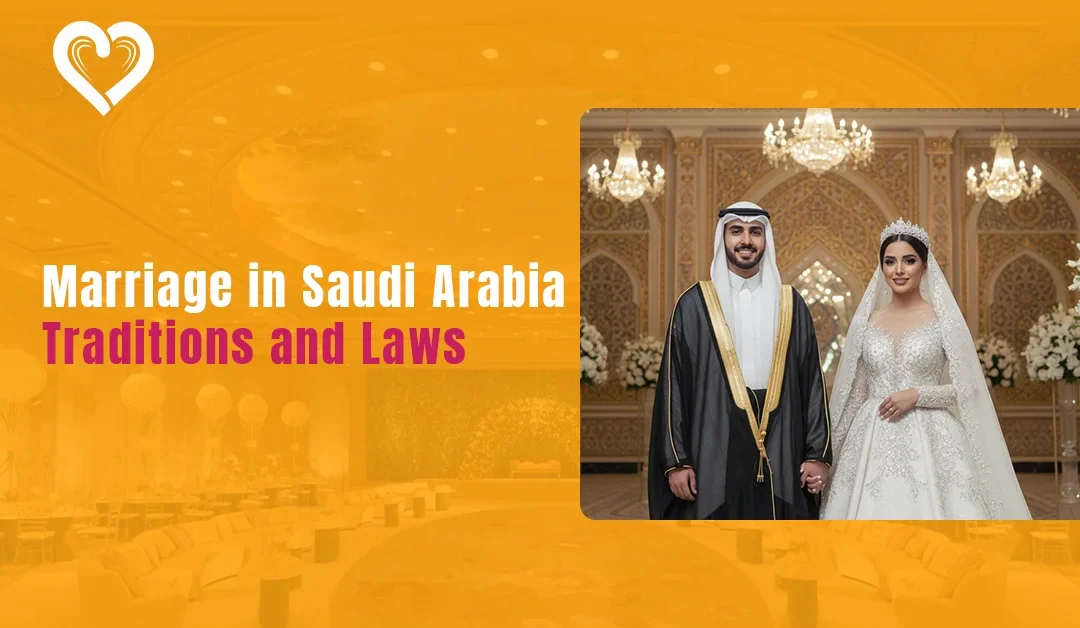
For many Pakistanis living in the Kingdom, marriage is a big concern. Some want to marry within Pakistani families. Others look for Saudi families or expats from other Muslim countries. To make the right decision, it is important to know how marriage works in Saudi Arabia. This includes traditions, laws, the legal age, and even platforms that help in finding a match.
Marriage in Saudi Arabia
First, let’s talk about the law. Saudi Arabia’s marriage laws are built on Islamic Sharia. This means Islamic principles guide the entire process. The government has also made recent updates to the Personal Status Law to protect everyone’s rights.
Legal Marriage Age in Saudi Arabia
One of the most important laws is the legal age of marriage. In the past, child marriages were allowed. But new reforms changed this. The new law now sets the minimum age for both girls and boys. This is a significant step to prevent child marriage and protect young people. According to the new law:
- The minimum age for marriage is 18 years.
- If someone is under 18, they need court approval.
- Marriages under the age of 15 are strictly banned.
- A special court can review 17-year-old cases ONLY if the wedding will happen after the 18th birthday.
Marriage Laws in Saudi Arabia
Saudi Arabian marriages follow the rules of Sharia (Islamic law). It is not just about the wedding ceremony. In fact, it is a legal contract. Key rules include:
- Both the bride and groom must agree to the marriage.
- A wali (guardian) is required for the bride.
- Two male witnesses must be present.
- The groom must give Haq mehr to the bride.
- A couple must get a pre-marital medical certificate to check for genetic and infectious diseases.
- Non-Muslims cannot marry Muslims in Saudi Arabia.
Traditions in Saudi Marriages
Saudi weddings look like fairy tales. Gold-lit halls. Drums. Dance. Dates and Arabic coffee. In fact, Saudi weddings are a beautiful blend of ancient customs and modern celebrations. While traditions can vary by family and region, some elements are common everywhere. These practices also highlight how wedding traditions across different cultures may differ, yet all share the same spirit of joy and togetherness.
1. Pre-Wedding Rituals
The Proposal (Khitbah)
It all starts when the groom’s family formally asks for the bride’s hand from her father or guardian. This is a respectful and formal event.
The Henna Night
A few days before the wedding, the bride typically hosts a special party with her female friends and relatives. During this celebration, they enjoy music and dancing. In addition, they adorn the bride’s hands and feet with beautiful henna art, creating a festive and joyful atmosphere.
2. The Wedding Celebration
Separate Celebrations
A key tradition is that men and women celebrate in separate halls. This arrangement ensures that everyone feels comfortable and can fully enjoy the party. Moreover, to respect privacy, even the waiters and photographers are female.
On the other hand, the women’s side is known for its incredible glamour, with beautiful dresses and lots of dancing. Overall, this separation allows both sides to celebrate freely while honoring cultural norms.
The Zaffa
This is the grand entrance of the groom into the women’s hall. First, it’s a lively procession with music and dancing, marking his official arrival to be with his bride.
Afterward, the couple spends time on a decorated stage, taking photos and receiving congratulations from friends and family. Finally, the celebrations continue with more socializing and joyful moments.
Walima Ceremony
The wedding dinner or Walima ceremony is a lavish banquet. Typically, families prepare a huge feast for their guests, full of delicious traditional dishes. For example, mandi, a whole roasted lamb on rice, is the highlight. In some weddings, even a whole camel is cooked and served.
Can Pakistanis Marry in Saudi Arabia?
Yes! Pakistanis can marry in Saudi Arabia. However, the process depends on who they are marrying. So, let us break it down.
Pakistani to Pakistani Marriage in Saudi Arabia
Thousands of Pakistanis live and work in Saudi Arabia. Many want to marry within their own community. Fortunately, the process is relatively straightforward, as the essential muslim marriage rules remain the same, although there are a few additional requirements set by the Saudi government.
In fact, the law lets them do it without the big hurdles. For instance, both the boy and the girl must be at least 18 lunar years old. Moreover, they must hold valid Iqamas, since visit visas are not enough for marriage registration.
Legal Age
- 18 lunar years is the hard line.
- The computer will reject any passport that shows 17.
- Bring your passport. NADRA “B” form or CNIC is not enough inside Saudi courts.
Get the CNI
First, they book an online slot at the Pakistan Embassy in Riyadh or Jeddah to get a Certificate of No Impediment, or CNI. Each person pays about one hundred riyals, shows a passport and Iqama, and signs a paper that says they are single. The embassy gives the CNI the same day.
- Book an appointment at pkembassy.org.sa → Consular Services.
- Upload passport, Iqama, passport-size photo.
- Pay SR 100 online.
- Visit the embassy on the date.
- Token at the gate
- Fingerprints
- Sign the affidavit in front of the consul
- Collect CNI the same day after 3 p.m.
Do this first, because every other office asks for CNI.
Medical Test
For marriage, you can visit approved clinics in different cities for medical tests. In Riyadh, Al-Falak charges 300 SR and delivers results within 24 hours. If you are in Jeddah, then go to the Saudi German Hospital. They charge 350 SR and send results in 24 hours.
In Dammam, Al-Mouwasat charges 300 SR and provides results in 48 hours. Tell the clinic the tests are for marriage, and they will email the results directly to the court.
Paper Checklist
- Passport and Iqama copies must be valid for at least 3 months.
- Certificate of No Impediment (CNI) must be valid for 3 months.
- Single-Status Affidavit must be valid for 3 months.
- Medical report from approved clinics, valid for 6 months, including HIV, Hepatitis B & C, and Thalassemia tests.
- The bride’s father must give guardian consent and bring his passport or Iqama.
- Two witnesses, such as friends or colleagues, must have a valid Iqama and bring original passports.
- Each bride and groom should provide four passport-size photos with a blue background.
- All foreign documents must be legalized and translated into Arabic by an accredited translator.
Booking the Nikah
- Create an Absher account (if the groom does not have one).
- Open Najiz.sa → Family Matters → New Marriage.
- Upload:
- CNI (both)
- Medical reports
- Iqama copies
- Guardian passport
- Choose date and time.
- Court sends confirmation SMS.
Day of Nikah
On the day of the Nikah, arrive about 30 minutes early. Security collects mobile phones, so bring a pen. The Ma’zoun (imam) asks the groom if he accepts the bride with the agreed dowry, and the groom replies, “Qabiltu” (I accept). The bride’s guardian also says, “Qabiltu.” The witnesses sign the contract, and you receive four stamped copies. The whole process takes around 20 minutes.
While the procedure in Saudi Arabia has its own requirements. It closely follows Islamic traditions, much like the marriage law in Pakistan. It also emphasizes consent, witnesses, and the Mehr.
Haq Mahr
- Write the exact amount in the contract.
- Can be cash, gold, or a deferred university fee.
- Courts reject joke amounts like SR 10.
- The average among Pakistanis is SR 5,000 – 20,000 or one tola of gold.
After Nikah
- Attest the marriage certificate at the Pakistan Embassy (free).
- Apply for NADRA marriage certificate online – you’ll need it for spouse visa later.
- Update marital status in Absher → Dependents → Edit. This helps when you apply for a family visit visa for rukhsati in Pakistan.
Can We Do a Big Pakistani-Style Wedding?
You can have a big Pakistani-style wedding in Saudi Arabia. However, you must complete the legal Nikah process first. Saudi authorities can shut down mixed-gender events without proper paperwork. Once you have the court certificate, you can book community halls, restaurants, or even rent a villa for a few days to hold wedding rituals.
You can include mehndi, dholki, and qawwali, but make sure to finish before 11 p.m. due to the noise curfew. Serve traditional dishes like biryani, qorma, nihari, or even Saudi dishes. Follow rules, serve halal food, avoid pork and alcohol.
Pakistani to Saudi Marriage
This process is more complex and involves strict government approval from the Saudi side. A Saudi citizen (man or woman) who wishes to marry a non-Saudi like a Pakistani national must first get a special permit from the Ministry of Interior (MOI).
1. Conditions for the Saudi Partner
The Saudi partner must meet certain conditions. For example, when a Saudi man wishes to marry a non-Saudi, there are often age requirements in most cases, which range between 30 and 70 years old, although exceptions can apply.
Furthermore, if he is already married to a Saudi woman, he may need to show proof of her medical issues or infertility.
2. Pakistani Partner Requirements
- A valid Iqama (residency permit) is usually required if residing in KSA.
- The Certificate of No Impediment to confirm you are free to marry.
- A foreign partner must not be deemed “undesirable” for reasons related to personality, nationality, or religion.
Once the permit is approved, then an authorized Ma’zoun (marriage officiant) documents the marriage contract and registers it in the Sharia court. Moreover, since both are Muslim, the marriage meets the fundamental requirements of Islamic Sharia.
Pakistani to Other Expat Marriage
If a Pakistani national is marrying a person of another non-Saudi nationality (e.g., Filipino, Indian, Egyptian, etc.), the rules are like the Pakistani-to-Pakistani process, but with one key difference.
1. Muslim to Muslim
If both expats are Muslim, they can typically marry at the Sharia Court (via the Ministry of Justice’s Najiz platform) or alternatively, at one of their respective country’s embassies or consulates that also provide this service.
- They must meet all standard Saudi requirements: valid Iqamas, pre-marital medical tests, mutual consent, and a bride’s guardian (Wali).
- All foreign documents must be legalized and translated into Arabic by an accredited translator.
2. Muslim to non-Muslim
- Pakistani Muslim man can marry a Christian or Jewish woman (Ehl-e-Kitaab).
- A Pakistani Muslim woman generally cannot marry a non-Muslim man unless he converts to Islam, as per Sharia law.
3. Non-Muslim to Non-Muslim
This marriage cannot be legally registered in a Saudi Sharia court. Therefore, the couple must marry at one of their country’s respective embassies that is authorized to perform marriages (such as the British or Philippine Embassies). If neither embassy offers this, then they may need to do marriage outside of Saudi Arabia.
Top 3 Matchmaking Platforms in Saudi Arabia
1. buzzArab
As a platform designed for Arabs and Muslims worldwide, it helps people connect based on culture and religion. It’s good for those looking for serious and meaningful relationships. Moreover, users can explore profiles and communicate in a safe, community-focused environment.
2. Mawada
As a free Muslim marriage platform, Mawada emphasizes traditional values and halal matchmaking. With over 9 million members, it allows Muslims to find serious, faith-based partners. In addition, the platform ensures that users can follow Islamic marriage rules, providing a secure and culturally respectful environment.
3. Simple Rishta
This family-focused matrimonial platform in Pakistan also serves Pakistanis living in Saudi Arabia. It enables users to find genuine matches, connect safely with genuine families, and follow a secure and trustworthy process for marriage.
Conclusion
In conclusion, marriage in Saudi Arabia blends tradition, religion, and legal requirements. Whether you are a Saudi, a Pakistani expat, or another foreigner, understanding the rules, such as legal age, Sharia compliance, medical tests, and proper registration, is essential.
Following these steps ensures a smooth Nikah. Moreover, it protects your rights and allows you to celebrate your wedding while respecting local customs and laws.
Frequently Asked Questions



Thank you for info