





Marriage holds great importance in everyone’s life. However, some relationships reach a stage where separation becomes the only practical option. Under Islamic and marriage law in Pakistan, Khula allows a woman to legally end her marriage when she cannot continue living with her husband.
Even though women have this legal right, many are still unaware of the Khula process in Pakistan. A Gallup Pakistan survey shows that almost 50% of Pakistanis do not fully understand Khula, and about 70% do not know that the Nikahnama includes a clause allowing women to initiate divorce.
Although 65% of people recognize Khula as a woman’s right, many still think society treats divorced women more harshly than men. Women usually seek Khula in Pakistan because of financial neglect or domestic violence.
Recent court data shows a sharp rise in Khula cases. Advocate Rubina Jatoi reported that in 2023, about 15,000 women in Karachi filed for divorce or Khula, mostly because their husbands failed to provide financial support.
Quetta Voice reported that about 1,000 Khula and divorce cases were filed in Quetta’s family courts in 2024, while The Express Tribune reported that thousands of cases have already been filed in Rawalpindi family courts this year. These numbers show that more women across Pakistan are using the Khula procedure in Pakistan as a legal solution when reconciliation fails.
What Is Khula?
Khula (خلع) is a type of divorce that a wife initiates to end her marriage. In this process, she returns her Haq mehr or any financial benefit she received at marriage. Unlike Talaq, which is the right of husband, Khula allows a Muslim woman to seek divorce with her husband’s consent or through a court order.
In Pakistan, the law clearly recognizes Khula. Women can approach the Family Court when they cannot live with their husband, and all reconciliation efforts fail.
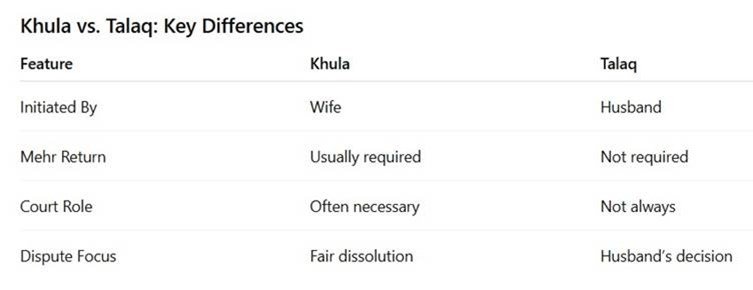
Khula vs Divorce: Key Differences
Here are the key differences between Khula and divorce:
- Initiated by: The wife initiates Khula, whereas the husband initiates’ divorce.
- Consent: In Khula, the husband does not need a consent, and similarly, the wife does not need to consent to divorce.
- Mehr (Dower): Typically, in Khula, the wife returns part of her mehr, while in Talaq, the wife retains her full mehr.
- Court Involvement: Khula often requires Family Court approval if contested; on the other hand, divorce can be pronounced directly by the husband without court involvement.
- Reason: Women seek Khula due to dissatisfaction, neglect, or cruelty, while husbands can give divorce unilaterally without stating a reason.
Key Differences Between Khula and Mubarat
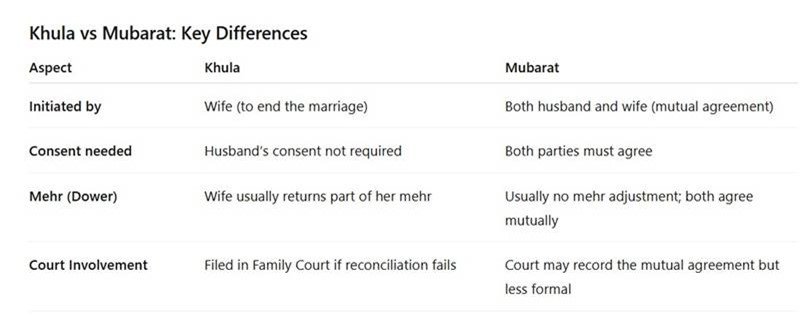
Here’s a simple comparison of Khula and Mubarat:
- Initiation: Unlike divorce, the wife initiates Khula, while both husband and wife agree on Mubarat.
- Consent: Husband’s consent is not needed for Khula, but both spouses must agree in Mubarat.
- Mehr (Dower): In Khula, the wife usually returns part of her mehr; while in Mubarat, no mehr adjustment is typically required.
- Court Role: The Family Court handles Khula cases if reconciliation fails, whereas Mubarat is recorded as a mutual agreement with minimal court involvement.
Khula in Islam
The basis of Khula comes from the Quran. It allows a wife to end her marriage if she cannot continue within the limits set by Allah. She may return her mehr as compensation.
ٱلطَّلَـٰقُ مَرَّتَانِ ۖ فَإِمْسَاكٌۢ بِمَعْرُوفٍ أَوْ تَسْرِيحٌۢ بِإِحْسَـٰنٍۢ ۗ وَلَا يَحِلُّ لَكُمْ أَن تَأْخُذُوا۟ مِمَّآ ءَاتَيْتُمُوهُنَّ شَيْـًٔا إِلَّآ أَن يَخَافَآ أَلَّا يُقِيمَا حُدُودَ ٱللَّهِ ۖ فَإِنْ خِفْتُمْ أَلَّا يُقِيمَا حُدُودَ ٱللَّهِ فَلَا جُنَاحَ عَلَيْهِمَا فِيمَا ٱفْتَدَتْ بِهِۦ ۗ تِلْكَ حُدُودُ ٱللَّهِ فَلَا تَعْتَدُوهَا ۚ وَمَن يَتَعَدَّ حُدُودَ ٱللَّهِ فَأُو۟لَـٰٓئِكَ هُمُ ٱلظَّـٰلِمُونَ
[al-Baqarah 2:229]
“Divorce may be retracted twice, then the husband must retain ˹his wife˺ with honour or separate ˹from her˺ with grace. It is not lawful for husbands to take back anything of the dowry unless the couple fears not being able to keep within Allah’s limits. Whoever transgresses Allah’s limits are the wrongdoers.”
Islam recognizes both spouses’ right to dissolve a marriage. The husband has the legal right of Talaq, while a wife can exercise her right through Khula if it is not already granted in the Nikah nama.
Grounds for Khula
A woman may seek Khula in Pakistan for several reasons, including:
- Desertion by the husband for 4 years
- Failure to provide maintenance for 2 years
- Husband contracting polygamy without legal procedures
- He has been imprisoned for 7 years.
- Failure to perform marital obligations for 3 years
- If the husband has been impotent since the time of marriage
- He has suffered from insanity or a serious illness for 2 years.
- Husband’s association with women of ill repute
- He shows cruelty, including physical abuse or unequal treatment of co-wives.
- If husband forces wife into immoral acts
- Preventing wife from practicing her religion
- Any other grounds recognized under Muslim law
Pakistani law fully covers Khula, including the Muslim Family Laws Ordinance, 1961, and other relevant legislation.
Conditions to Initiate Khula
Under the Khula procedure in Pakistan court, a wife can file for Khula only if certain conditions are met:
- Free Will: The wife must ask Khula willingly, without anyone forcing her.
- Determined Not to Live with Husband: The wife must show she cannot continue living with the husband.
- No Need to Prove Hatred: She doesn’t have to explain why; just saying she cannot live with him is enough.
Documents Required for Khula
- Provide a copy of your CNIC or Passport
- Include the Nikahnama
- Attach the Marriage Certificate
For those who don’t know the difference, the Nikahnama serves as the Islamic marriage contract. The bride, groom, and witnesses sign it during the Nikah ceremony, and it records details such as names, CNIC numbers, marriage date, Mehr (dower), and any special clauses (e.g., the wife’s right to Khula). On the other hand, the government issues the Marriage Certificate to officially register the marriage. It serves as proof of marriage for legal matters like passports, inheritance, and other official records.
What is the Procedure of Khula in Pakistan?
1. Filing a Case
The wife files a suit for dissolution of marriage in Family Court. Claims may include dower, maintenance, custody, and property rights.
2. Intimation to Husband (Khula Notice)
Then the court sends the husband a notice to appear in person or through a lawyer.
3. Husband’s Response
- When the husband does not appear, the court proceeds without him.
- On the other hand, if the husband appears, he submits a written statement and may request restitution of conjugal rights.
4. Pre-trial Proceedings
The court attempts reconciliation between the spouses.
- If Reconciliation Fails: The court dissolves the marriage and may direct the wife to return part of her dower (up to 50% of deferred dower or 25% of prompt dower).
- When reconciliation succeeds: Then court passes a decree based on compromise.
5. Recording Evidence
The court records statements from both parties and their witnesses, if they have any.
6. Judgment and Decree
Next, the court makes a final effort to reconcile the couple. If reconciliation fails, the court issues a Khula decree and sends copies to the husband and relevant authorities.
7. Notification to Arbitration Council
The Family Court sends a copy of the Khula decree to the Union Council or Arbitration Council, which attempts reconciliation for up to 90 days.
Khula Procedure for Overseas Pakistanis & Foreigners
Women living abroad can appoint a representative through a Special Power of Attorney (SPA) to file for Khula:
- Appoint a representative in Pakistan via SPA attested by a Pakistani consulate.
- The representative files the Khula case in Family Court.
- After a court decree, the representative submits documents to the Arbitration Council or Union Council.
- If reconciliation fails after 90 days, a Divorce Certificate (Talaq-e-Mubarat) is issued.
Documents Required for Overseas Khula
- NICOP or POC
- Passport copy
- Marriage Certificate or Nikah nama
- Attested Special Power of Attorney
- Supporting documents and evidence
Khula Procedure in Pakistan in Urdu
Aurat apne haq mein apni shadi khatam karne ke liye Khula ka tareeqa istemal karti hai. Khula ke liye aurat aksar apna haq mehr wapas karti hai aur Family Court ke zariye shadi khatam karwati hai. Pakistan ka qanoon Khula ko tasleem karta hai aur aurat Family Court mein case dakhil kar sakti hai.
Qanoon ke mutabiq, aurat apne wakil ke zariye Family Court mein Khula ki darkhwast file karti hai, jismein Khula ki waja, jaise ke shohar ka rawaiya, bad-sulooki, ya na-nfaqa na dena, wazeh ki jati hai. Court phir shohar ko notice bhejti hai, aur agar dono ke darmiyan mufahimat na ho, to Court Khula ki decree jaari karti hai. Is decree ke mutabiq, biwi mehr wapas karti hai, aur iske baad talaq waqiya ho jati hai.
Conclusion
The number of Khula cases in Pakistan is increasing, showing that more women are aware of their legal rights. By knowing what the procedure of Khula in Pakistan is, women can take legal steps to protect their rights. Both local and overseas Pakistani women can file for Khula with the help of the courts or authorized representatives.
Frequently Asked Questions
What are the rules for Khula in Pakistan?
A wife can file for Khula voluntarily if she cannot live with her husband. She may need to return part of her mehr, and the Family Court handles the process according to Pakistani law.
How long does it take to get Khula in Pakistan?
The duration depends on the case complexity, reconciliation attempts, and court schedule. It can take a few months to complete.
Can a woman file for Khula during pregnancy?
Yes, a wife can apply during pregnancy, but Khula becomes legally effective only after delivery.
What are the modes of marriage dissolution in Pakistan?
- Talaaq-i-Tafweez: The husband gives his wife the right to divorce in the Nikahnama, and she can use it if needed.
- Mubarat: Both husband and wife agree to separate by mutual consent.
- Talaq: The husband can divorce his wife on his own without her consent.
Can a wife claim Haq Mehr after Khula?
Yes, up to 50% of deferred dowers (Gher Muajjal Haq Mehr) can be claimed.
Is online Khula possible?
Yes, through the E-Court System. Statements and evidence can be submitted via video call. It is useful for overseas Pakistanis or cases with Special Power of Attorney.
Can a woman file Khula before Rukhsati?
Yes, a woman can seek Khula before Rukhsati. It is not affected by customary formalities.
What is child custody law after Khula?
Child custody rules remain the same as other divorces; Khula does not change custody rights.
Can a Husband Reject Khula?
No, a husband cannot reject Khula. His agreement is not required, and the court can grant Khula even if he opposes it.
What if the Husband Does Not Agree to Khula?
The husband’s consent is not required for Khula. Even if he disagrees, the court will proceed with the case. If he contests, the court may try to reconcile the couple, but if the wife still refuses to live with him, the court will grant Khula.
Can a husband appeal to a Khula decree?
No, a husband cannot appeal to a Khula decree once the Family Court grants it. Section 14(2) of the Family Courts Act, 1964 bars appeal against Khula to protect women’s rights, making the decision final even if the husband disagrees. However, in rare cases, a husband can appeal if the Khula is granted on specific grounds of cruelty, such as abuse, immoral conduct, or denial of the wife’s legal rights under the Dissolution of Muslim Marriages Act, 1939. In most Khula cases, the court does not allow an appeal.
What are the fees for Khula in Pakistan?
The divorce costs in Pakistan vary depending on the lawyer you hire and the complexity of the Khula case. Simple cases may cost less, while contested or complicated cases can be more expensive.
Is it mandatory to observe Iddah after Khula?
Yes, after Khula, a woman must observe a three-month Iddah period to confirm she is not pregnant and to ensure the child’s paternity before she can remarry.
Does a woman get maintenance during Iddah?
Yes, a woman is entitled to receive maintenance during the three-month Iddah period.
Can an overseas Pakistani or foreign wife file for Khula in Pakistan?
Yes, via Special Power of Attorney and the E-Court System. The process is treated the same as local citizens.
What are the common issues faced in Khula?
Lack of awareness, social stigma, returning mehr, court delays, child custody disputes, and husband contesting the case.